Guide
ChatGPT for tilers (UK)
Shaun Holmes
ChatGPT prompts for UK tilers: quotes with square metres and adhesive or grout allowances, prep and drying notes, job lists, invoices, and reviews.
A tiler can open ChatGPT in the van and turn a voice note into a quote, a note on the substrate, or a job list the customer can read on a phone. That is useful when the price, the square metres, and the adhesive and grout allowances are already in the note. It is a mess if the draft invents a coverage, a drying time, or a promise that the wall is ready.
I've spent over 20 years in UK construction. Plastering and drylining is my trade, and I have worked alongside tilers. I am not one. The price, the measurements, and the decision about the background stay with the person who looked at the wall or the floor. We search the AI world every week so you don't have to. The wider jobs, for any trade, are in the ChatGPT for tradesmen guide. Plastering, which is my trade, is ChatGPT for plasterers and dryliners (UK). Decorating around the tiling is ChatGPT for painters and decorators (UK). The same shape of page for the trades on the job is ChatGPT for builders (UK), ChatGPT for plumbers (UK), ChatGPT for electricians (UK), ChatGPT for joiners and carpenters (UK), and ChatGPT for roofers (UK). Gas work, for the registered engineer, is ChatGPT for gas engineers (UK).
Use a chat tool for the sentences. Do not use it to set a price, to invent a square metre, or to decide that a background is ready to tile.
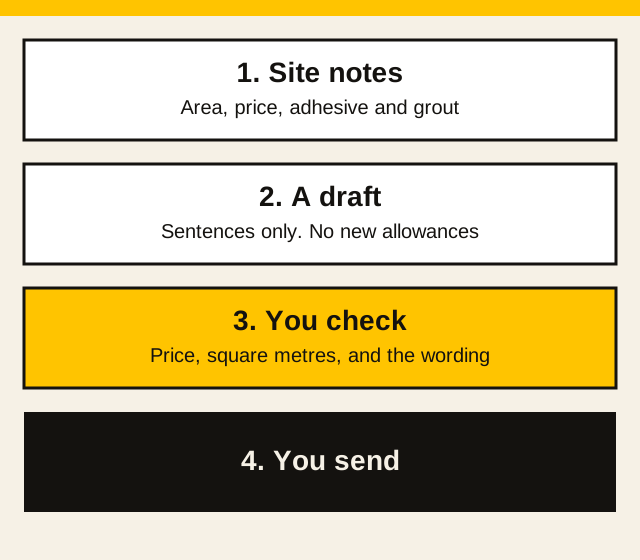
Do it in this order:
- Walk the job. Write the rooms, wall or floor, the tile, the substrate, who buys the materials, and what is not included. Fix the voice note before you paste it.
- Decide the price. Work the tile count, and the adhesive and grout allowances, before you open the chat. The tile calculator does that sum from measurements you type. It does not set the price.
- Paste the notes into one prompt below. Leave the full address out.
- Read every figure against the note. Then send it yourself.
Last checked: 5 Nov 2026.
| Job | Use a chat tool for | Do not use it for |
|---|---|---|
| Quote, prep note, job list, invoice, review reply | The sentences, once you have typed the facts | The price, a square metre, an allowance, or a promise you have not made |
| Substrate and drying | A message from the line you are willing to send | A number of weeks, or a promise the background is ready, unless you typed it |
| Cutting tiles | Nothing about whether the dust is safe | HSE's silica dust page (opens in a new tab). The silica dust toolbox talk is the Monday briefing |
Quotes with square metres and allowances
Walk the job first. Talk the note in short lines: rooms, wall or floor, the tile size you measured, the joint, who supplies the tiles, what the background is, and what is not included. Moving the suite, tanking, and making good the decoration are the usual lines people forget. Voice typing on the phone is enough. Fix any word it got wrong before you paste. Decide the price. The tool does not know what you need to earn.
Count the tiles, and the adhesive and grout, before you fill the prompt. The tile calculator turns an area into tiles from the size and the joint you type, adds the wastage you type, and rounds up. It does not assume how many tiles are in a box. You type that number from the box. Adhesive and grout on that page use the area you are tiling, not the extra tiles in the wastage.
The adhesive figures are BAL SPF S1 (opens in a new tab), a 20 kg bag, data sheet issued May 2025, which I read on 5 November 2026. Dry wall is 0.6 m² per kilogram with a 4 mm notched trowel, or 0.5 m² per kilogram with a 6 mm notch. A wet wall, solid bed, 6 mm notch, is 0.4 m² per kilogram. Floors and outside, 10 mm notch, solid bed, is 0.26 m² per kilogram. The sheet says coverage may vary with the surface and the trowel. If you are not using that adhesive, those rows are not your rows. The tub you are buying is the figure.
Grout on the calculator is BAL Grout (opens in a new tab), also issued May 2025, for joints up to 3 mm. The sheet prints four coverage rows, not a figure for every tile. If your tile, thickness and joint are not one of those rows, the calculator does not invent a grout weight. Pack sizes on that sheet are 20 kg, 10 kg, 3.5 kg and 1.5 kg. The sheet says coverage may vary. Type the allowance you have already worked out. Do not ask the chat to look up a bag count.
You are helping a UK tiler write a quote. UK English. Use pounds.

Do not add rooms, tile sizes, joints, square metres, adhesive allowances, grout allowances, drying times, dates, or prices that are not in the notes. Do not say the wall or the floor is ready to tile. Do not calculate a coverage. If something important is missing, write [still to confirm] and leave it blank.

Notes from the visit:
[paste your voice note, after you have corrected it]

Price I have already decided: £[amount]
Area I measured: [square metres]
Tile and joint I measured: [paste]
Adhesive allowance I have already worked out: [product, and bags or kilograms]
Grout allowance I have already worked out: [product, and bags or kilograms, or "not on this quote"]
Who supplies the tiles: [me / the customer]
VAT: [not registered / included at 20% / added at 20%]
Not included: [paste]

Write a short quote the customer can read on a phone. Put the price near the top. Put the area and the allowances in the lines they belong to. List what is not included. End by asking them to reply yes if they want the job booked.
List the exclusions for this tiling quote as short lines a customer can read on a phone. Use only the exclusions I give you. Do not soften them, and do not add new ones. UK English.

Exclusions: [paste]
Read every number against your notes before you send it. Extra work after they have said yes, a background that was not the one you priced, is a variation note, with a new figure you have decided, not a new price from the chat. The longer quoting pages are AI for quoting jobs and the quote template.
Write a short variation note for extra tiling on a UK job. UK English. Use pounds.

Do not add rooms, square metres, allowances, or a price I did not write. Do not say the original quote still covers this. If something is missing, write [still to confirm].

What changed: [paste]
Why: [paste]
New figure I have decided: £[amount]
What it does to the time: [paste, or "not agreed yet"]
Ask: reply yes before I start this extra
Get it free every week
A weekly email on quotes, customer texts, and the notes that follow a tiling job.
Prep, substrate and drying times
This is the text I would not let a chat tool invent. Customers want a day they can use the shower, or a promise the new plaster is ready. The draft has to use the line you are willing to send, for the product you are actually buying.
British Gypsum's White Book plaster systems (opens in a new tab), which I read on 5 November 2026, says impermeable finishes, including tiles, should not be applied until the background and plaster are dry. A permeable paint can be used in the interim. The same document says tiles up to 20 kg/m² can be applied directly to Thistle finish coats, except where the system includes a bonding agent. Where there is a bonding agent, the total weight of tiles and plaster over it is limited to 20 kg/m². It says that if plastering to provide a background for tiles, avoid polishing the surface. Polished plaster should be roughened and a suitable primer used. The plasterer's side of that conversation is the plasterers guide.
The BAL SPF S1 sheet is a different product note, and only for that adhesive. It says plaster, finish coat only, must be at least 4 weeks old before tiling. The plaster must be free from dust, laitance and friable material. If it is shiny or polished, brush it thoroughly with a stiff bristled brush. The sheet says the plaster must always be primed with 2 coats of BAL PRIME APD undiluted, or BAL BOND SBR diluted 1:2 by volume with clean cold water, the second coat at 90 degrees to the first, and each coat left to dry. It sets a maximum of 20 kg/m² for tiling onto plaster. It says the use of plaster is not recommended in commercial wet rooms or domestic power showers. Plasterboard, on the same sheet, has to be dry, securely fixed and rigid, with a maximum of 32 kg/m², and the same note against commercial wet rooms and domestic power showers. Where plasterboard is dot and dabbed, at 300 mm centres and around the perimeter, the sheet says leave it to dry before tiling.
The same sheet says grout after 16 hours at 20°C. It says those times will be extended in colder temperatures, when fixing to impervious backgrounds, or when fixing tiles of low porosity. It says the adhesive is not suitable for metal, painted surfaces, plywood walls, or tiling onto existing glazed tiles. Do not let a draft say otherwise.
BAL Grout (opens in a new tab), which I read the same day, says it sets in 24 hours at 20°C. The application notes say allow about 15 minutes at 20°C, or until the surface is dry to the touch, before cleaning. That is not fully set. The BAL SPF S1 sheet also says not to use a shower for at least 2 weeks after grouting is complete, and it points that line at the latest BS 5385: Part 4. I have not read that British Standard. The line I am willing to repeat is the one BAL printed.
If the tub in your hand is a different adhesive or a different grout, none of those times are yours to paste. Read that tub. Type the line you will stand by.
Write a short text to a UK customer about prep, the substrate, and drying after tiling. UK English. Polite and plain.

Use only the line I give you. Do not add a number of hours, days, or weeks. Do not say the background is ready. Do not name a primer, an adhesive, or a grout I did not write. Do not add a date they can use the shower or the floor.

What I will tell them: [paste the line you are willing to send]
Substrate I saw: [paste]
What is not included: [tanking / decoration / other, as I have written]
Cutting those tiles can put silica dust in the air. HSE's silica dust page (opens in a new tab), which I read on 5 November 2026, says silica is a major constituent of construction materials such as bricks, tiles, concrete and mortar, and that cutting, drilling, grinding and polishing generate dust. It says some of that dust is fine enough to get deep into the lungs, and that this fine dust, respirable crystalline silica, is too fine to see with normal lighting. The silica dust toolbox talk is the briefing before the cutter comes out. A chat tool does not choose the control.
Job lists
A job list is the rooms and the order you already decided. The tool can put your lines under headings. It cannot add a room, a cut, or a bag you did not type. If you have not counted the tiles yet, leave the quantity blank and use the tile calculator first.
Turn these notes into a job list for a UK tiling job. UK English. Keep my order. Keep my quantities. Do not add rooms, tasks, tile sizes, or bag counts I did not write. If a quantity is missing, write [quantity].

Job: [one line, no house number]
List:
[paste]
Invoices
GOV.UK's invoice page (opens in a new tab) is the list of what an invoice has to include. The invoice and late-payment guide is the longer version, including the difference between a business customer and a householder. Put the bank details on the invoice you send. Do not paste them into the chat. If you are not VAT registered, do not let a draft add a VAT line.
Draft a UK invoice from these notes for tiling. UK English. Do not invent prices, dates, quantities, addresses, or bank details. If something is missing, write [missing: what] and leave it blank.

Trading name: [name]
Customer: [name]
Work: [what you did, including the area if I typed it]
Amount: £[amount]
VAT: [not registered / 20%]
Invoice date: [date]
A chaser is the invoice number, the amount, and the date you sent it. Do not ask the tool to invent a late fee, or to threaten court, unless you have already decided to say that.
Write a short polite chaser for an unpaid UK tiling invoice. UK English. Do not add interest, a late fee, or a threat of court unless those words are already in my notes. Do not change the amount or the dates.

Invoice number: [number]
Amount: £[amount]
Date I sent it: [date]
What the work was: [one line]
How I want paying: [bank transfer to the details already on the invoice]
Review replies
A reply to a review is public. No surname, no address, no price, and no argument about the substrate in the comments. The reviews guide is the longer check for Checkatrade and Google.
Draft a public reply to this review of tiling work. UK English. No surname, no address, no job price. Thank them if there is a fair point. Say how they can contact me. Do not argue about the finish. Under 80 words.

Review: [paste]
How they can reach me: [phone or email]
Which tool for which job
These are tools already used in the guides on this site. I am not copying a price or a message cap. Those change. The company's own page is the place to read them on the day you pay.
| Job | A tool that suits it | What it is for |
|---|---|---|
| The wording: a quote, a prep note, a job list, an invoice, or a review reply | ChatGPT (opens in a new tab), Gemini (opens in a new tab) or Copilot (opens in a new tab) | Sentences. The free tools guide is the wider list, Claude included. |
| The enquiry, the diary, the quote and the invoice in one place | Tradify (opens in a new tab) or ServiceM8 (opens in a new tab) | Job management. What their own sites say is on the tradesmen guide and the quoting apps guide. |
| The books | FreeAgent (opens in a new tab) | Accounting software. The tradesmen guide links FreeAgent's own page. |
What not to paste in
Leave these out, even when they are already on the phone:
- the customer's full address, and a photo of the room if the house number or a face is in the shot
- card numbers, one-time codes from texts, and bank details
- your UTR
- a tiling schedule or a plan that still has the name and address on it
The reasons, the photos and drawings, and the training switches in ChatGPT, Gemini and Claude, are in what not to put into ChatGPT. A town and the work is enough for the draft. Put the address back in the message you send yourself.
What this will not do
It will not measure a room. It will not tell you the plaster is dry, or which adhesive the background needs. It will not turn a bag count into a labour price. It will not remember that the customer wants the bathroom finished before a family visit. It will not get you paid.
Use one job this week. A quote you were going to write anyway is the right size. The prompts above are the start. The guides linked from each section are the detail.
Common questions
Can ChatGPT price a tiling job?
No. You type the price you have already decided, and the square metres from the visit. ChatGPT can turn those notes into a quote. The tile calculator counts tiles from the size and the joint you type, and adhesive or grout only where the BAL sheet has a figure. It does not set the price.
Can it tell a customer when they can use the shower?
No. The BAL SPF S1 sheet says grout after 16 hours at 20°C, and not to use a shower for at least 2 weeks after grouting, pointing that line at BS 5385: Part 4. Those times are for that sheet. The draft uses the line you type. It must not add a time from a different product.
What should a tiler not paste in?
The customer's full address, a photo that shows the house number or a face, card numbers, one-time codes, bank details, your UTR, and a tiling schedule that still has the name and address on it. The guide on what never to paste into ChatGPT is the longer list.
Get it free every week
Free when you sign up: the UK Trades AI Prompt Pack, with prompts for quotes, chasing payment, tax admin, and customers.