Guide
ChatGPT for joiners and carpenters (UK)
Shaun Holmes
ChatGPT prompts for UK joiners and carpenters: fitted-work quotes, cutting lists, options emails, snag messages, and a scope from workshop notes.
A joiner or carpenter can open ChatGPT in the van, or on the bench, and turn workshop notes into a quote, a cutting list in plain lines, or an email about the options the customer still has to pick. That is useful when the price, the sizes, and what is not included are already written down. It is a mess if the draft invents a length, a timber size, or a lintel.
I've spent over 20 years in UK construction. Plastering and drylining is my trade, and I have worked alongside joiners and carpenters. I am not one. The price, the sizes, and any opening in a load-bearing wall stay with the person who measured the job. We search the AI world every week so you don't have to. The wider jobs, for any trade, are in the ChatGPT for tradesmen guide. Building work around the joinery is ChatGPT for builders (UK). The same shape of page for the trades next to this one is ChatGPT for roofers (UK), ChatGPT for plasterers and dryliners (UK), ChatGPT for painters and decorators (UK), ChatGPT for electricians (UK), ChatGPT for plumbers (UK), and ChatGPT for tilers (UK). Gas work, for the registered engineer, is ChatGPT for gas engineers (UK).
Use a chat tool for the sentences. Do not use it to set a price, to invent a size, or to decide whether an opening, a lintel, or a beam is sound.
Last checked: 3 Nov 2026.
| Job | Use a chat tool for | Do not use it for |
|---|---|---|
| Fitted-work quote, cutting list, options email, snag or remedial message, customer-facing scope | The sentences, once you have typed the facts | The price, a length, a quantity, or a promise you have not made |
| Structure | Nothing | Whether an opening, a lintel, or a beam can be altered. HSE's page on structural stability (opens in a new tab) is the official note |
| Electrics in the kitchen or the stair | Nothing | Moving lights or adding a circuit. That is the electricians guide |
A quote for fitted work
Measure first. Note the room, what they asked for, who supplies the timber or the units, the ironmongery if it is in the price, and what is not included. Fix any word the phone got wrong. Decide the price. Then ask for the sentences.
HSE's page on structural stability during alteration, demolition and dismantling (opens in a new tab) says that work must be planned and carried out by competent people so the structure does not collapse when nobody planned for it. The same page says a competent person should survey the structure before potentially load-bearing parts are altered, a suitably qualified engineer should decide if temporary support is needed, and you should consult the local authority building control department before structural alterations. If the job includes an opening or a lintel, name the person who is responsible for that part. Do not let a draft decide it.
You are helping a UK joiner write a quote for fitted work. UK English. Use pounds.

Do not add rooms, products, lengths, quantities, dates, or prices that are not in the notes. Do not give a timber size, a lintel size, or a structural method. Do not say an opening is safe. If something important is missing, write [still to confirm] and leave it blank.

Notes from the visit:
[paste your notes, after you have corrected them]

Price I have already decided: £[amount]
Who supplies the materials: [me / the customer]
VAT: [not registered / included at 20% / added at 20%]
Not included: [paste]

Write a short quote the customer can read on a phone. Put the price near the top. List what is not included. End by asking them to reply yes if they want the job booked.
The longer quoting pages are AI for quoting jobs and the quote template. Shorter prompts for several trades are in 25 AI prompts for builders.
Get it free every week
A weekly email on fitted-work quotes, cutting lists, and customer messages.
A cutting list, from sizes you supply
A cutting list is the lengths and quantities you already measured or took off a drawing you trust. The tool can turn a messy note into lines you can take to the saw or the merchant. It must not fill a blank with a guess. A guessed length is a short piece, or a wasted one.
Turn these notes into a cutting list for a UK joiner. UK English. Use millimetres.

Do not add a length, a width, a thickness, or a quantity that is not in my list. Do not change a number. If a size is missing, write [size]. If a quantity is missing, write [quantity].

List:
[paste your lines, including the sizes you measured]
Read every number against the note before you cut. The chat is not the rod.
An email about customer options
The customer still has to pick a handle, a colour, a glass, or which way a door hangs. Write the choices you are actually offering. Ask the tool to put them in an email. Do not let it add a third option, a price, or a lead time you did not type.
Write a short email so a UK customer can pick from these options. UK English. Use only the options I list. Do not add an option, a price, a date, or a product I did not name. If a price is missing, write [price].

Job: [one line, no house number]
Options:
[paste]
What I need back from them: [which option, by when if I have named a day]
A snag or remedial message
A snag on fitted work is a door that catches, a gap you have seen, a handle the customer has asked to change. Describe what you saw. The tool can make the sentences calmer. It must not say the work is acceptable, and it must not invent a cause.
Write a short message about a snag or a remedial visit on fitted joinery. UK English.

Do not add defects, rooms, dates, or prices that are not in the notes. Do not say the work is acceptable. Do not invent a cause. If the date of the visit is not in my notes, write [date still to confirm].

What I saw, or what they reported: [paste]
What I have already agreed to do: [paste, or "nothing agreed yet"]
Price for the extra, if I have decided one: £[amount, or "no extra price"]
If the extra has a new price, the variation note is the message to get a written yes before you start.
Workshop notes into a customer-facing scope
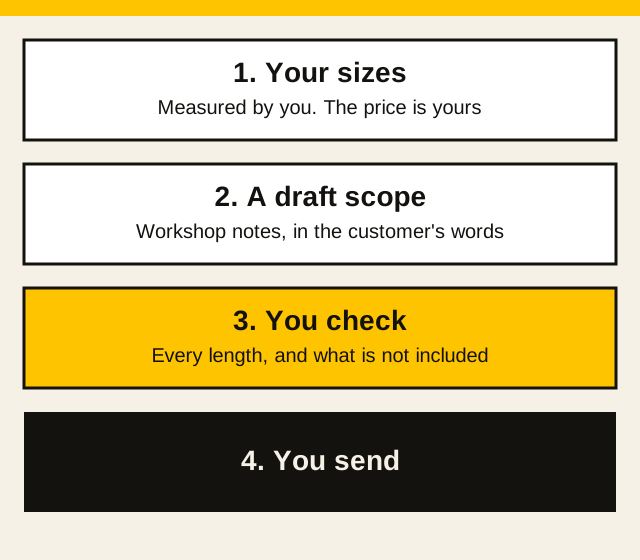
The note on the bench is for you: species, handing, which face is finished, what is site-fixed. The customer needs the same job in plain lines, without the workshop shorthand, and without a promise you did not make.
Turn these workshop notes into a short scope a UK customer can read. UK English.

Do not add items, sizes, finishes, dates, or prices that are not in the notes. Keep every exclusion. If a finish or a size is missing, write [still to confirm].

Notes:
[paste]

Price I have already decided, if it belongs in this message: £[amount, or "leave the price out"]
Not included: [paste]
You still read it. If the draft has swapped handing, or added making good the plaster, put your words back.
Which tool for which job
These are tools already used in the guides on this site. I am not copying a price or a message cap. Those change. The company's own page is the place to read them on the day you pay. The wider list is the free tools guide.
| Job | A tool that suits it | What it is for |
|---|---|---|
| The wording: a quote, a cutting list, an options email, a snag message, or a scope | ChatGPT (opens in a new tab), Gemini (opens in a new tab) or Copilot (opens in a new tab) | Sentences. Claude is on the free tools guide. |
| The enquiry, the diary, the quote and the invoice in one place | Tradify (opens in a new tab) or ServiceM8 (opens in a new tab) | Job management. What their own sites say is on the tradesmen guide and the quoting apps guide. |
| The books | FreeAgent (opens in a new tab) | Accounting software. The tradesmen guide links FreeAgent's own page. |
What not to paste in
Leave these out, even when they are already on the phone:
- the customer's full address, and a photo that shows the house number or a face
- card numbers, one-time codes from texts, and bank details
- your UTR
- a drawing title block that still has the name and address on it
The reasons, and the training switches in ChatGPT, Gemini and Claude, are in what not to put into ChatGPT. A town and the work is enough for the draft. Put the address back in the message you send yourself.
What this will not do
It will not measure an opening. It will not price the timber. It will not size a lintel or tell you a wall can be cut. It will not know which way the customer wanted the door to hang if you did not write it down. It will not get you paid.
Use one job this week. A quote for fitted work you were going to write anyway is the right size. The prompts above are the start. The guides linked from each section are the detail.
Common questions
Can ChatGPT price fitted joinery or fill in a cutting list?
No. You type the price you have already decided, and the sizes you measured. ChatGPT can turn those notes into a quote or a tidy list. It must not invent a length, a quantity, or a timber size.
Can it say an opening or a lintel is safe?
No. HSE's page on structural stability says that work must be planned and carried out by competent people, and that a competent person should survey the structure before potentially load-bearing parts are altered. A chat tool does not do that survey.
What should a joiner or carpenter not paste in?
The customer's full address, a photo that shows the house number or a face, card numbers, one-time codes, bank details, your UTR, and a drawing title block that still has the name and address on it. The guide on what never to paste into ChatGPT is the longer list.
Get it free every week
Free when you sign up: the UK Trades AI Prompt Pack, with prompts for quotes, chasing payment, tax admin, and customers.