Guide
ChatGPT for painters and decorators (UK)
Shaun Holmes
ChatGPT prompts for UK painters and decorators: quotes, colour and finish notes, prep and snagging lists, customer updates, and payment chasers.
A decorator can open ChatGPT in the van and turn room notes into a quote, a note on the finish, a snagging list, or a chaser. That is useful when the price, the prep, and the colour they actually asked for are already written down. It is a mess if the draft invents a sheen, a drying time, or a promise that old paint is safe to sand.
Plastering and drylining is my trade. I have spent more than 20 years in UK construction, and I have worked alongside painters and decorators. I am not one. The prep, the finish, and the price stay with the decorator who looked at the room. We search the AI world every week so you don't have to. The wider jobs, for any trade, are in the ChatGPT for tradesmen guide. The same shape of page for the trades next to this one is ChatGPT for builders (UK), ChatGPT for roofers (UK), ChatGPT for joiners and carpenters (UK), ChatGPT for plasterers and dryliners (UK), ChatGPT for plumbers (UK), ChatGPT for electricians (UK), and ChatGPT for tilers (UK). Gas work, for the registered engineer, is ChatGPT for gas engineers (UK). The Monday briefing for this trade is the toolbox talks for painters and decorators.
Use a chat tool for the sentences. Do not use it to set a price, to choose a finish the customer did not ask for, or to decide that old paint is safe to rub down.
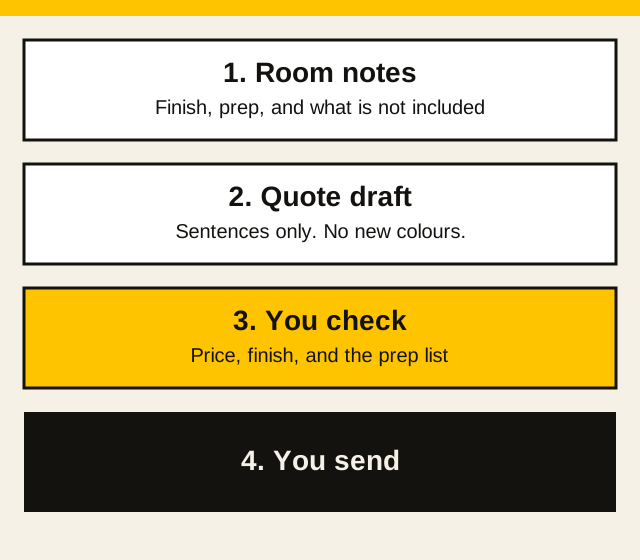
Do it in this order:
- Walk the rooms. Write the finish they asked for, the prep, who buys the paint, and what is not included.
- Decide the price. The paint calculator turns the area and the coverage you type into litres and tins. It does not price the job.
- Paste the notes into one prompt below. Leave the full address out.
- Read every figure against the note. Then send it yourself.
Last checked: 1 Nov 2026.
| Job | Use a chat tool for | Do not use it for |
|---|---|---|
| Quote, finish note, snagging list, update, chaser | The sentences, once you have typed the facts | The price, a colour, or a promise you have not made |
| New plaster | A message from the line you are willing to send | A number of days until they can paint, unless you typed it |
| Old paint | Nothing about whether it is safe to dry-sand | The old lead paint talk and the painters' toolbox talks |
Quotes
Walk the job first. Note the rooms, the finish, whether ceilings are in, who buys the paint, and what is not included. Furniture moving, wallpaper stripping, and making good after another trade are the lines that get left off. Decide the price. Then paste the notes.
If the walls have just been plastered, the drying line is not a guess for the chat. British Gypsum's Thistle MultiFinish data sheet (opens in a new tab), which I read on 1 November 2026, says make sure Thistle plasters are thoroughly dry before decorating, although a coat of permeable paint can go on in the interim. The plasterer's side of that text is the plasterers guide.
You are helping a UK painter and decorator write a quote. UK English. Use pounds.

Do not add rooms, colours, finishes, coat counts, dates, or prices that are not in the notes. Do not say the walls are ready. If something important is missing, write [still to confirm] and leave it blank.

Notes from the visit:
[paste your voice note, after you have corrected it]

Price I have already decided: £[amount]
Finish they asked for: [paste]
Who buys the paint: [me / the customer]
VAT: [not registered / included at 20% / added at 20%]
Not included: [paste]

Write a short quote the customer can read on a phone. Put the price near the top. List what is not included. End by asking them to reply yes if they want the job booked.
List the exclusions for this decorating quote as short lines a customer can read on a phone. Use only the exclusions I give you. Do not soften them, and do not add new ones. UK English.

Exclusions: [paste]
Read every number against your notes before you send it. Extra work after they have said yes is a variation note, with a new figure you have decided. The longer quoting pages are AI for quoting jobs and the quote template.
Get it free every week
A weekly email on quotes, customer texts, and the notes that follow a job.
Colour and finish
The customer asked for a finish. Write that name down. The chat can turn it into a sentence they can read. It must not swap matt for silk, and it must not invent a colour code.
Dulux Decorator Centre's priming guide (opens in a new tab) says surfaces that are already painted and in good condition can be overcoated after cleaning and a light sand. The same page says to use matt paint as an undercoat if there is a dramatic colour change, even if you are finishing with soft sheen or silk. It also says bare plaster that is drying out should be coated with a breathable finish such as Dulux Trade Supermatt, and that bare plaster that is fully dry may be primed with a thinned first coat of Vinyl matt, which that page calls a mist coat. Bare plasterboard, on that page, should be primed with Dulux Trade Drywall Primer Sealer. I am not copying a thinning ratio. The tin you are buying is the ratio.
How many litres that room needs, from the coverage you type, is the paint calculator. The figure on the tin still wins if it differs.
Explain this paint finish in plain English for a UK customer who is not a decorator. UK English.

Use only the finish name and the notes I paste. Do not change the finish. Do not add a colour code, a brand, a coat count, or a drying time I did not write. Do not say it will look the same as a photo.

Finish they asked for: [paste]
What I have already told them about prep: [paste]
What is not included: [paste]
Prep and snagging lists
A prep list is the work you already decided to do before the finish goes on. A snagging list is what you saw at the end, in your own words. The tool can put those lines under headings. It cannot add a rub-down, a filler coat, or a crack you did not type.
If the job is rubbing down paint in an older house, read the old lead paint talk and HSE's page on lead in construction (opens in a new tab) before a draft says the paint is fine to dry-sand. The toolbox talks for painters and decorators put that next to solvents and ladders. The chat has not seen the coating.
Turn this list into a prep list for a decorating job. UK English. Keep my order. Do not add tasks, products, or coat counts I did not write. If a line is vague, write [still to confirm] and leave it.

Rooms: [paste]
Prep I will do: [paste]
Prep I will not do: [paste]
Turn these notes into a short snagging list for a UK decorating job. UK English. Use only the faults I paste. Do not add faults. Do not say the job is finished. Do not promise a date I did not write.

What I saw: [paste]
What I have already agreed to put right: [paste, or "nothing agreed yet"]
Customer updates
Most updates are one line: which room is done, you are running late, they can use the room when you say so. Write those yourself. Use the tool when the first draft would be rude, or when they have asked three things and you want them in a calmer order.
Rewrite this as a short text to a UK customer about decorating in progress. Polite, plain, no jargon. Do not add a date, a colour, a drying time, or an apology I did not write. Do not say they can move back in unless those words are already here. Keep every fact that is already here.

Message:
[paste what you would have sent]
If the message is a scam text that looks like a customer or a supplier, that is a different problem. The scam texts guide is the check before you tap a link.
Chasing payment
A chaser is the invoice number, the amount, and the date you sent it. Do not ask the tool to invent a late fee, or to threaten court, unless you have already decided to say that.
GOV.UK's invoice page (opens in a new tab) is the list of what an invoice has to include. The invoice and late-payment guide is the longer version, including the difference between a business customer and a householder. Use that page for the legal lines. The prompt below is the short chaser.
Write a short polite chaser for an unpaid UK decorating invoice. UK English. Do not add interest, a late fee, or a threat of court unless those words are already in my notes. Do not change the amount or the dates.

Invoice number: [number]
Amount: £[amount]
Date I sent it: [date]
What the work was: [one line]
How I want paying: [bank transfer to the details already on the invoice]
Put the bank details on the invoice you send. Do not paste them into the chat.
Which tool for which job
These are tools already used in the guides on this site. I am not copying a price or a message cap. Those change. The company's own page is the place to read them on the day you pay.
| Job | A tool that suits it | What it is for |
|---|---|---|
| The wording: a quote, a finish note, a snagging list, an update, or a chaser | ChatGPT (opens in a new tab), Gemini (opens in a new tab) or Copilot (opens in a new tab) | Sentences. The free tools guide is the wider list, Claude included. |
| The enquiry, the diary, the quote and the invoice in one place | Tradify (opens in a new tab) or ServiceM8 (opens in a new tab) | Job management. What their own sites say is on the tradesmen guide and the quoting apps guide. |
| The books | FreeAgent (opens in a new tab) | Accounting software. The tradesmen guide links FreeAgent's own page. |
What not to paste in
Leave these out, even when they are already on the phone:
- the customer's full address, and a photo of the room if the house number or a face is in the shot
- card numbers, one-time codes from texts, and bank details
- your UTR
- a colour schedule that has the customer's name and address on the same page, until you have taken those off
The reasons, the photos and drawings, and the training switches in ChatGPT, Gemini and Claude, are in what not to put into ChatGPT. A town and the work is enough for the draft. Put the address back in the message you send yourself.
What this will not do
It will not measure a room. It will not match a colour from a photo of a cushion. It will not tell you old paint is safe to sand. It will not remember that the customer wants the hall finished before a family visit. It will not get you paid.
Use one job this week. A quote you were going to write anyway, or one snagging list from notes you already made, is the right size.
Common questions
Can ChatGPT price a decorating job?
No. You type the price you have already decided, and the rooms, the finish, and the prep. The paint calculator turns an area and a coverage you type into litres. It does not price the labour.
Can it choose the colour or the finish?
No. You type the finish the customer asked for. The chat can turn that into a plain sentence. It must not swap matt for silk, invent a colour code, or say old paint is safe to dry-sand.
What should a decorator not paste in?
The customer's full address, a photo that shows the house number or a face, card numbers, one-time codes, bank details, your UTR, and a colour schedule that still has the name and address on it. The guide on what never to paste into ChatGPT is the longer list.
Get it free every week
Free when you sign up: the UK Trades AI Prompt Pack, with prompts for quotes, chasing payment, tax admin, and customers.