Guide
ChatGPT for electricians (UK)
Shaun Holmes
ChatGPT prompts for UK electricians: rewires, consumer units, EV charger quotes, a plain EICR note, customer texts, materials and invoices you check.
A spark can open ChatGPT in the van and turn site notes into a quote, a text, or a plain sentence about a report the customer is staring at. That is useful when the price, the scope, and the code on the certificate are already yours. It is a mess if the draft invents a cable size, a code, or a promise that the installation is satisfactory.
Plastering and drylining is my trade. I have spent more than 20 years in UK construction, and I have worked alongside electricians. I am not one, and I do not sign an electrical certificate. The test, the code, and the signature stay with the electrician who did the work. We search the AI world every week so you don't have to. The wider jobs, for any trade, are in the ChatGPT for tradesmen guide. The same shape of page for plumbing is ChatGPT for plumbers (UK). Gas work, for the registered engineer, is ChatGPT for gas engineers (UK). Plastering, which is my trade, is ChatGPT for plasterers and dryliners (UK). Decorating is ChatGPT for painters and decorators (UK). Building work is ChatGPT for builders (UK). Roof work is ChatGPT for roofers (UK). Fitted joinery is ChatGPT for joiners and carpenters (UK). Wall and floor tiling is ChatGPT for tilers (UK).
Use a chat tool for the sentences. Do not use it to design a circuit, size a cable, choose a protective device, or decide a code on a report.
Last checked: 31 Oct 2026.
| Job | Use a chat tool for | Do not use it for |
|---|---|---|
| Quote, text, materials list, invoice | The sentences, once you have typed the facts | The price, a cable size, or a promise you have not made |
| An EICR the customer has to read | Plain words for a code and an observation you already wrote | Choosing the code, or saying the installation is satisfactory |
| Gas | Nothing | That is the gas engineers guide and the plumbers guide. The gas work stays with a Gas Safe registered engineer |
Quotes for a rewire, a consumer unit, or an EV charger
Walk the job first. Note what they asked for, what you saw at the consumer unit, whether the job is a new circuit, and what is not included. Decide the price. Then paste the notes.
Approved Document P (opens in a new tab) is the Building Regulations guidance for electrical safety in dwellings in England. The edition on that page sets out the electrical installation work that is notifiable: installing a new circuit, replacing a consumer unit, or any addition or alteration to existing circuits in a special location. A rewire, a consumer unit change, and an EV charger that needs a new circuit sit in that list when they are that work. I am not going to guess a job from a photo.
GOV.UK's page on competent person schemes (opens in a new tab) says an installer who is registered with a scheme can self-certify that the work complies with building standards, tell the local authority if needed, and give a certificate within 8 weeks of completion. The chat tool does not join a scheme, and it does not send that certificate.
The IET's BS 7671 page (opens in a new tab), which I read on 31 October 2026, says the transition period for BS 7671:2018+A2:2022 (Amendment 2) ended on 15 October 2026. It says Amendment 2 should no longer be referenced for new electrical installation work, project specifications, certification or compliance, and that BS 7671:2018+A4:2026 (Amendment 4) is the current edition. Your certificate names the edition you worked to. Do not let a draft name a different one.
If you want to test a day rate, a VAT threshold, or a CIS deduction before the quote goes out, the calculators are here: the day rate calculator, the VAT threshold checker, and the CIS deduction calculator. None of them has seen the job. The price on the quote is still the one you decided.
You are helping a UK electrician write a quote for a rewire. UK English. Use pounds.

Do not add rooms, circuits, cable sizes, protective devices, dates, or prices that are not in the notes. Do not say the installation will be satisfactory. If something important is missing, write [still to confirm] and leave it blank.

Notes from the visit:
[paste]

Price I have already decided: £[amount]
VAT: [not registered / included at 20% / added at 20%]
Not included: [paste]
Making good decoration: [included / not included, as I have written]

Write a short quote the customer can read on a phone. Put the price near the top. List what is not included. End by asking them to reply yes if they want the job booked.
You are helping a UK electrician write a quote to replace a consumer unit. UK English. Use pounds.

Do not add circuits, device ratings, dates, or prices that are not in the notes. Do not promise that the rest of the installation is satisfactory. If something important is missing, write [still to confirm] and leave it blank.

Notes:
[paste]

Price I have already decided: £[amount]
What is included: [paste]
Not included: [paste]
VAT: [not registered / included at 20% / added at 20%]

Write a short quote the customer can read on a phone. Put the price near the top. Say what is not included.
You are helping a UK electrician write a quote for an EV charger. UK English. Use pounds.

Do not add a charger model, a cable size, a supply capacity, a grant, or a price that is not in the notes. If the notes do not say whether a new circuit is included, write [still to confirm]. Do not say the existing supply is adequate.

Notes:
[paste]

Price I have already decided: £[amount]
Charger supply: [who buys it]
New circuit: [included / not included, as I have written]
Not included: [paste]
VAT: [not registered / included at 20% / added at 20%]

Write a short quote the customer can read on a phone. Put the price near the top. List what is not included.
List the exclusions for this electrical quote as short lines a customer can read on a phone. Use only the exclusions I give you. Do not soften them, and do not add new ones. UK English.

Exclusions: [paste]
Read every number against your notes before you send it. Extra work after they have said yes is a variation note, with a new figure you have decided. The longer quoting pages are AI for quoting jobs and the 25 prompts.
Get it free every week
A weekly email on quotes, customer texts, and the notes that follow a job.
A plain-English note on an EICR
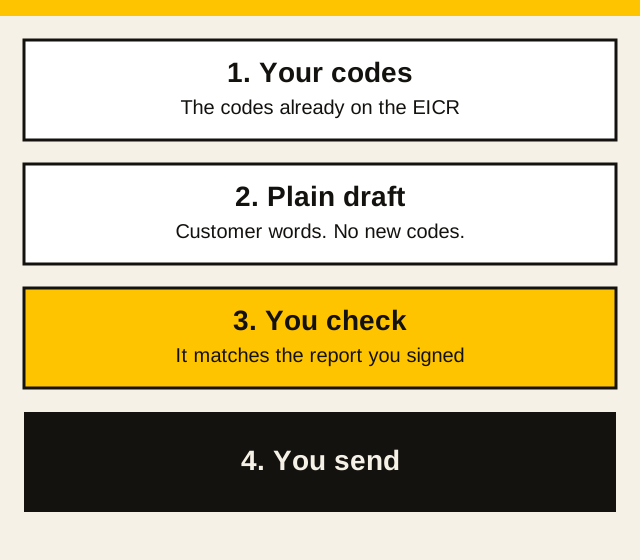
The electrician who inspected the installation is the person who chooses the code and signs the report. A chat tool can turn that code, and the observation you already wrote, into a sentence a customer can read. It must not change the code, and it must not say the installation is satisfactory if the report does not say that.
Electrical Safety First's page on periodic inspection (opens in a new tab) says the check should be carried out only by electrically competent persons, such as registered electricians, against BS 7671. It says the competent person then issues an Electrical Installation Condition Report detailing damage, deterioration, defects, dangerous conditions and non-compliances. It says that if anything dangerous or potentially dangerous is found, the overall condition is declared unsatisfactory.
For landlords in England, GOV.UK's electrical safety guidance (opens in a new tab), published 1 November 2025, is the page I am using. It says the regulations require landlords to have the electrical installations inspected and tested by a qualified person at least every 5 years, and to obtain a report, usually an EICR. The regulations (opens in a new tab) define a qualified person as a person competent to undertake the inspection and testing, and any further investigative or remedial work, in accordance with the electrical safety standards. The same GOV.UK page says the standards are the 18th edition of the Wiring Regulations, published as British Standard 7671. The IET page above is where the current amendment of that edition is named.
That GOV.UK page lists the classification codes as:
- Code 1 (C1): Danger present. Risk of injury.
- Code 2 (C2): Potentially dangerous.
- Code 3 (C3): Improvement recommended. Further remedial work is not required for the report to be deemed satisfactory.
- Further Investigation (FI): Further investigation required without delay.
On that page, C1 or C2 means remedial work is required and the report will state the installation is unsatisfactory for continued use. FI means the landlord must have the investigation carried out. C3 is a recommendation, not a requirement to do the work. The guidance was published on 1 November 2025. The sentence you send has to match the code on the report you signed. If the form in front of you words a code differently, use the form.
Electrical Safety First's page also says this inspection is a legal requirement across the whole of the UK for privately rented homes, and that in Scotland and Wales it also covers socially rented homes. I have not set out the Scottish or Welsh statutes here. The England detail is the GOV.UK guidance and the regulations linked above.
Explain this EICR result in plain English for a UK customer who is not an electrician. UK English.

Use only the codes and the observations I paste. Do not change a code. Do not say the installation is satisfactory unless the report says that. Do not add remedial work I did not write. If a code has no observation next to it, write [observation missing].

Overall result on the report I signed: [satisfactory / unsatisfactory]
Codes and observations, in my words:
[paste]
What I have already told them I will do next: [paste, or "nothing agreed yet"]
You still read it against the report before it goes out. Once you send it, it is your sentence. The certificate stays yours.
Customer messages
A customer who wants a price from a photo of a consumer unit has not had the job looked at. Do not let the draft give a number.
Reply to this message from a UK customer. UK English. Polite and short. Do not give a price. Do not say whether the installation is safe. Ask only for the facts I list.

Facts I still need: [paste, for example photos of the consumer unit with the door open, the address of the job, and when they can be in]
Their message:
[paste]
Materials lists
A materials list is the items you already decided to take. The tool can put them under headings. It cannot add a drum of cable, a breaker, or a gland you did not type.
Turn this list into a materials list for an electrical job. UK English. Keep my quantities. Do not add items, cable sizes, or brands I did not write. If a quantity is missing, write [quantity].

Job: [one line]
List:
[paste]
Invoices
GOV.UK's invoice page (opens in a new tab) is the list of what an invoice has to include. The invoice and late-payment guide is the longer version. Put the bank details on the invoice you send. Do not paste them into the chat.
Draft a UK invoice from these notes for electrical work. UK English. Do not invent prices, dates, quantities, addresses, or bank details. If something is missing, write [missing: what] and leave it blank.

Trading name: [name]
Customer: [name]
Work: [what you did]
Amount: £[amount]
VAT: [not registered / 20%]
Invoice date: [date]
Which tool for which job
These are tools already used in the guides on this site. I am not copying a price or a message cap. Those change. The company's own page is the place to read them on the day you pay.
| Job | A tool that suits it | What it is for |
|---|---|---|
| The wording: a quote, a text, a materials list, or a plain note from an EICR you already wrote | ChatGPT (opens in a new tab), Gemini (opens in a new tab) or Copilot (opens in a new tab) | Sentences. The free tools guide is the wider list, Claude included. |
| The enquiry, the diary, the quote and the invoice in one place | Tradify (opens in a new tab) or ServiceM8 (opens in a new tab) | Job management. What their own sites say is on the tradesmen guide and the quoting apps guide. |
| The books | FreeAgent (opens in a new tab) | Accounting software. The tradesmen guide links FreeAgent's own page. |
What not to paste in
Leave these out:
- the customer's full address, and a photo of a certificate or a consumer unit if the address is in the shot
- card numbers, one-time codes from texts, and bank details
- your UTR, and a scheme membership number the draft does not need
- test results from a different job that is still in the same chat
The reasons, and the training switches in ChatGPT, Gemini and Claude, are in what not to put into ChatGPT. A town and the work is enough for a first draft. Start a fresh chat when the job changes.
What this will not do
It will not design a circuit. It will not make an EICR true. It will not put you on a competent person scheme. It will not remember that the customer wants the cooker circuit finished before the kitchen fitters arrive. It will not get you paid.
Use one job this week. A quote you were going to write anyway, or one paragraph explaining a code you have already chosen, is the right size.
Common questions
Can ChatGPT decide an EICR code?
No. The electrician who inspected the installation chooses the code and signs the report. GOV.UK's guidance for landlords in England, published 1 November 2025, describes C1, C2, C3 and FI. A chat tool can only turn the code you already wrote into a plain sentence. It must not say the installation is satisfactory unless the report says that.
Can it size a cable or design a consumer unit?
No. Those decisions stay with the electrician. The chat writes the sentences for a quote, a materials list, or an invoice from notes and a price you have already decided.
What should an electrician not paste in?
The customer's full address, a photo of a certificate if the address is in the shot, card numbers, one-time codes, bank details, and your UTR. The guide on what never to paste into ChatGPT is the longer list, including the training switches.
Get it free every week
Free when you sign up: the UK Trades AI Prompt Pack, with prompts for quotes, chasing payment, tax admin, and customers.