Guide
ChatGPT for roofers (UK)
Shaun Holmes
ChatGPT prompts for UK roofers: quote wording from survey notes, weather-delay updates, repair or replace, scaffold chases, and guarantee letters.
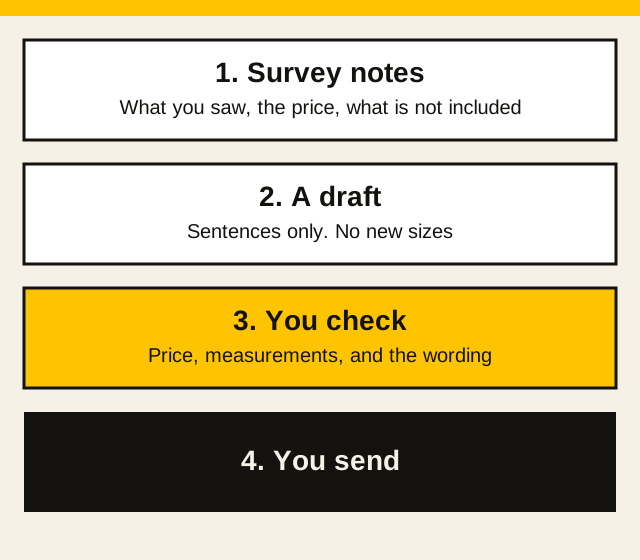
A roofer can open ChatGPT in the van and turn survey notes into a quote, a weather update, or a letter the customer can read on a phone. That is useful when the price, the measurements, and what is not included are already in the note. It is a mess if the draft invents a size, a tile, a date, or a promise that the roof is safe to walk.
I've spent over 20 years in UK construction. Plastering and drylining is my trade, and I have worked alongside roofers. I am not one. The price, the measurements, and any decision about how the work at height is done stay with the person who looked at the roof. We search the AI world every week so you don't have to. The wider jobs, for any trade, are in the ChatGPT for tradesmen guide. Building work around the roof is ChatGPT for builders (UK). The same shape of page for the trades on the job is ChatGPT for joiners and carpenters (UK), ChatGPT for plumbers (UK), ChatGPT for electricians (UK), ChatGPT for plasterers and dryliners (UK), ChatGPT for painters and decorators (UK), and ChatGPT for tilers (UK). Gas work, for the registered engineer, is ChatGPT for gas engineers (UK). The Monday briefing for this trade is the toolbox talks for roofers.
Use a chat tool for the sentences. Do not use it to set a price, to invent a measurement, or to decide whether a roof is safe to work on.
Last checked: 4 Nov 2026.
| Job | Use a chat tool for | Do not use it for |
|---|---|---|
| Quote, weather update, repair or replace, scaffold or supplier chase, guarantee letter | The sentences, once you have typed the facts | The price, a measurement, a duration, or a promise you have not made |
| Work at height | Nothing | Whether the roof is safe, or which access to use. HSE's roof work page (opens in a new tab) and HSE's step-by-step guide on work at height (opens in a new tab) are the official notes |
| Fragile roofs, cement sheets, lead | Nothing | Whether a sheet will hold a person, or whether to drill or burn it. HSE's fragile surfaces page (opens in a new tab) is the official note. The toolbox talks for roofers are the Monday briefings |
Quote wording from survey notes
Walk the roof first, in the way you already plan the job. Talk the note in short lines: what they asked for, what you measured, the covering you actually saw, who buys the materials, how you want the work sequenced, and what is not included. Voice typing on the phone is enough. Fix any word it got wrong before you paste. Read the figures out loud against the note. Then decide the price. The tool does not know what you need to earn.
HSE's roof work page (opens in a new tab) says you must organise and plan all roof work so it is carried out safely. The same page says all work on roofs is highly dangerous, even if a job only takes a few minutes, and that those carrying out the work must be trained, competent and instructed in use of the precautions required. It says almost one in five deaths in construction work involve roof work. Some are specialist roofers, but many are just repairing and cleaning roofs. It says the main causes of death and injury are falling from roof edges or openings, through fragile roofs and through fragile rooflights.
The same page says sloping roofs require scaffolding to prevent people or materials falling from the edge, and that you must also fit edge protection to the eaves of any roof, and on terraced properties to the rear as well as the front. It says that where work is of short duration (tasks measured in minutes), properly secured ladders to access the roof and proper roof ladders may be used. For flat roofs, it says falls from flat roof edges can be prevented by simple edge protection arrangements: a secure double guardrail and toeboard around the edge. It says all roofs should be treated as fragile until a competent person has confirmed they are not.
HSE's fragile surfaces page (opens in a new tab) says falls through fragile surfaces, particularly fibre-cement roofs and rooflights, account for 22% of all fall from height fatal injuries in the construction industry. HSE's step-by-step guide (opens in a new tab) puts the order as avoid working at height, then prevent a fall, then minimise the distance and the consequences. It says that for each step you consider what is reasonably practicable and use collective protection before personal protection. A chat tool is not the competent person on that roof, and it does not choose the scaffold.
You are helping a UK roofer write a quote from survey notes. UK English. Use pounds.

Do not add slopes, measurements, materials, tile or slate names, dates, durations, or prices that are not in the notes. Do not say the roof is safe to walk on. Do not choose scaffolding, a ladder, edge protection, or any other access. Do not say a sheet, a rooflight, or lead is safe to work on. If something important is missing, write [still to confirm] and leave it blank.

Notes from the survey:
[paste your notes, after you have corrected them]

Price I have already decided: £[amount]
Who supplies the materials: [me / the customer / named supplier]
VAT: [not registered / included at 20% / added at 20%]
Not included: [paste]

Write a short quote the customer can read on a phone. Put the price near the top. List what is not included. End by asking them to reply yes if they want the job booked.
Read every number against your notes before you send it. Extra work after they have said yes is a variation note, with a new figure you have decided, not a new price from the chat. The longer quoting pages are AI for quoting jobs and the quote template.
Get it free every week
A weekly email on quotes, customer texts, and the notes that follow a roof job.
A customer update after a weather delay
Most updates are one line: the rain stopped the covering, the wind stopped the scaffold, you need a dry day before the next coat or the next course. Write those yourself when they are short. Use the tool when the note is messy and you want it in an order the customer can follow. Do not invent a new date, and do not offer a discount you have not decided.
Rewrite this as a short update to a UK customer after weather stopped roof work. Polite, plain, no jargon. Do not add a discount, a new date, a site visit, or an apology I did not write. If the new date is not in my notes, write [date still to confirm]. Do not say the roof is weathertight unless those words are already in my notes.

What happened: [paste]
What I am doing next: [paste]
What I need from them: [paste, or "nothing"]
If the delay changes the price or the work, that is the variation note, not a softer sentence in this text.
Repair or replace, in plain English
You decide which option you are willing to offer, and the price of each. The tool turns that into sentences a customer can follow. It must not add an option you did not type, and it must not say one of them is the safe choice.
Turn these notes into a short plain-English note for a UK customer, comparing the roof options I am offering. UK English. Use pounds.

Use only the options, the measurements, and the prices I typed. Do not add an option. Do not say which one is safer, longer lasting, or better value. Do not say the roof is safe to leave. If a price or a measurement is missing, write [still to confirm].

What I saw, in my words: [paste]
Option A: [what it is] Price I have already decided: £[amount]
Option B: [what it is] Price I have already decided: £[amount]
What is not included in either: [paste]
Read it back against the survey note. If a third option appears, take it out. If the two prices have swapped, put yours back.
Chasing scaffold and suppliers
A chase is the order or the hire reference, what you asked for, and the date you were given, if you were given one. Do not ask the tool for today's merchant price, a lead time, or a product code it has not been shown. Do not ask it to design the scaffold. HSE's roof work page (opens in a new tab) is the note on edges and access. The hire company and the person who planned the job still own that.
Write a short chase to a UK scaffold hire company or a roofing supplier. Polite, plain, no jargon. Do not invent a delivery date, a hire date, a price, or a product code. If I have not typed it, write [still to confirm]. Do not describe how the scaffold should be built.

Who I am chasing: [scaffold hire / supplier]
Reference: [order or hire reference]
What I asked for: [paste]
What they told me, if anything: [paste, or "nothing written down"]
What I need from them: [a date / a call back / the missing item]
Send it from your own email or the account you ordered on. Do not paste card numbers or account passwords into the chat.
A guarantee and aftercare letter
The guarantee is the period and the limit you are willing to put in writing. Type both. The tool must not invent a number of years, and it must not widen what you cover. Aftercare is the same: only the visits or the advice you already decided to offer.
Write a short guarantee and aftercare letter for roof work I have finished. UK English.

Use only the period, the limit, and the aftercare I typed. Do not add years, a workmanship promise, or a materials promise that is not in the notes. Do not say the roof is guaranteed weathertight unless those words are already in the notes. If a date or a period is missing, write [still to confirm].

What the work was: [one line, no house number]
Guarantee I am willing to give: [paste the period and what it covers]
What it does not cover: [paste]
Aftercare I have already decided: [paste, or "none"]
How they can reach me: [phone or email]
Read it twice. A sentence that adds a year, or that covers storm damage you did not type, comes out before you send it.
Which tool for which job
These are tools already used in the guides on this site. I am not copying a price or a message cap. Those change. The company's own page is the place to read them on the day you pay. The wider list is the free tools guide.
| Job | A tool that suits it | What it is for |
|---|---|---|
| The wording: a quote, a weather update, a repair or replace note, a chase, or a guarantee letter | ChatGPT (opens in a new tab), Gemini (opens in a new tab) or Copilot (opens in a new tab) | Sentences. Claude is on the free tools guide. |
| The enquiry, the diary, the quote and the invoice in one place | Tradify (opens in a new tab) or ServiceM8 (opens in a new tab) | Job management. What their own sites say is on the tradesmen guide and the quoting apps guide. |
| The books | FreeAgent (opens in a new tab) | Accounting software. The tradesmen guide links FreeAgent's own page. |
What not to paste in
Leave these out, even when they are already on the phone:
- the customer's full address, and a photo of the front of the house if the house number is in the shot
- card numbers, one-time codes from texts, and bank details
- your UTR, and a password for a merchant or a scaffold account
- drawings or a scaffold plan with a title block that still has the name and address on it
The reasons, and the training switches in ChatGPT, Gemini and Claude, are in what not to put into ChatGPT. A town and the work is enough for the draft. Put the address back in the message you send yourself.
What this will not do
It will not price the job. It will not measure a roof, a gutter, or a scaffold. It will not decide that a roof is safe to walk, that a sheet will hold you, or that a ladder is enough. It will not tell you which way to satisfy HSE's roof work page (opens in a new tab). It will not remember that the customer wants the house dry before a family visit.
Use one job this week. A quote you were going to write anyway is the right size. The prompts above are the start. The guides linked from each section are the detail.
Common questions
Can ChatGPT price a roofing job?
No. You type the price you have already decided, and the notes from the survey. ChatGPT can turn those notes into a quote. It has not seen the roof, and it does not know what you need to earn.
Can it decide if a roof is safe to work on?
No. HSE's roof work page says all work on roofs is highly dangerous, even if a job only takes a few minutes, and that all roofs should be treated as fragile until a competent person has confirmed they are not. A chat tool is not that person.
What should a roofer not paste in?
The customer's full address, a photo that shows the house number, card numbers, one-time codes, bank details, your UTR, and a drawing or scaffold plan if the title block still has the name and address on it. The guide on what never to paste into ChatGPT is the longer list.
Get it free every week
Free when you sign up: the UK Trades AI Prompt Pack, with prompts for quotes, chasing payment, tax admin, and customers.