Guide
ChatGPT for gas engineers (UK)
Shaun Holmes
ChatGPT prompts for UK gas engineers: quotes, cover notes, updates and invoice chases. You keep the safety decision.
A gas engineer can open ChatGPT on the phone and turn notes they already wrote into a quote, a cover note, a customer update, or an invoice chase. That is useful when the price, the scope, and the words on the record are already theirs. It is the wrong tool if the draft decides an appliance is safe, classifies a defect, says the work is fine or compliant, invents a reading, or rewrites the defect line.
Plastering and drylining is my trade. I have spent more than 20 years in UK construction. I am not a gas engineer, and I am not Gas Safe registered. The safety decision on this page stays with the engineer who is. We search the AI world every week so you don't have to. The wider jobs, for any trade, are in the ChatGPT for tradesmen guide. Plumbing that is not gas work is ChatGPT for plumbers (UK). Sparks are ChatGPT for electricians (UK). Building work around the install is ChatGPT for builders (UK). Wall and floor tiling is ChatGPT for tilers (UK).
Use a chat tool for the sentences. Do not use it to decide whether an appliance is safe, to classify a defect, or to sign a gas safety record.
Last checked: 5 Nov 2026.
| Job | Use a chat tool for | Do not use it for |
|---|---|---|
| Quote, cover note, customer update, invoice chase | The sentences, once you have typed the facts | A date, a price, a reading, or a compliance claim you did not write |
| A landlord gas safety record | A cover note that repeats only the words already on the record, which you then check | Deciding whether an appliance is safe, classifying a defect, rewriting a defect line, or signing the record |
| Electrics | Nothing | Moving lights or adding a circuit. That is the electricians guide |
Hard rules
ChatGPT must never do any of these. If the draft does one of them, delete that line before you send anything.
- Decide whether an appliance, a flue, or an installation is safe.
- Classify a defect, or add a category the record does not already use in your own words.
- Say something is fine, safe, satisfactory, passed, or compliant.
- Invent a reading, a date, a price, a registration number, or an address.
- Rewrite the defect wording from a gas safety record. A cover note repeats the words you already recorded. It does not tidy them.
- Replace Gas Safe competence, or stand in for the registered engineer who did the work.
Safety decisions stay with the registered engineer. The chat does not look at the appliance. It does not sign.
I read the pages below on 5 Nov 2026.
Regulation 3 of the Gas Safety (Installation and Use) Regulations 1998 (opens in a new tab) says no person shall carry out any work in relation to a gas fitting or gas storage vessel unless he is competent to do so. Subject to the two exceptions in paragraph (4) of that regulation, an employer must not allow an employee to carry out work in relation to a gas fitting or service pipework, and a self-employed person must not carry out that work, unless the employer or the self-employed person is a member of a class of persons approved by the Health and Safety Executive for that paragraph. A chat tool is not in that class, and it is not competent.
HSE's page for employers (opens in a new tab) says that in domestic properties, and in workplaces such as shops, restaurants, schools and hospitals, work on gas fittings must be carried out by a Gas Safe registered engineer who is qualified to do the work, and that it is illegal for anyone else to do it. The same page says that in factories, mines, quarries, agricultural premises, construction site huts and sewage works, the work must be carried out by a competent person, and that work on a gas fitting in any part of those premises used as domestic, residential or sleeping accommodation must still be carried out by a Gas Safe registered engineer. HSE says people who are registered carry a Gas Safe ID card, which shows the type of work they are qualified to do and whether their qualifications are up to date.
HSE's page on who can do a landlord gas safety check (opens in a new tab) says all such checks must be done by a Gas Safe registered engineer. HSE advises that you check the engineer is competent to work in that specific area of gas, and says this is clearly marked on the back of the engineer's Gas Safe Register registration card. The same page says a Gas Safe registered engineer must fit and check a gas appliance, and that it is not acceptable for a registered engineer to knowingly sign off gas work carried out by a person who is not registered.
Regulation 36 (opens in a new tab) is the landlord duty. Paragraph (3)(a) says each appliance and flue to which the duty extends is checked for safety within 12 months of being installed and at intervals of not more than 12 months since it was last checked for safety. Paragraph (6)(a) says a copy of the record is given to each existing tenant within 28 days of the date of the check. Paragraph (3)(c) lists what that record has to include.
HSE's page on gas safety check records (opens in a new tab) puts the same list in shorter lines: a description and the location of each appliance or flue checked; the name, registration number and signature of the individual carrying out the check; the date; the address of the property; the name and address of the landlord, or their agent where appropriate; any safety-related defect identified and any remedial action taken; and confirmation that the safety check included an examination of the matters in regulation 26(9)(a) to (d) of the same regulations. HSE says the Gas Safe registered engineer should only issue the record once all of the required checks have been completed. HSE says the landlord does not have to sign the record. The engineer does. HSE says any gas safety check record given after 1 April 2009 will only be valid if the engineer is registered with Gas Safe Register. HSE calls the form the landlord gas safety record, and says it was previously referred to as a gas safety record, certificate or CP12 form. HSE says Gas Safe Register does not produce its own gas safety check record form.
The cover note is not that record. The quote is not that record. If a sentence adds a defect, a reading, a model number, or the word "safe", delete it.
Get it free every week
A weekly email on quotes, customer texts, and the notes that follow a gas job.
On the phone
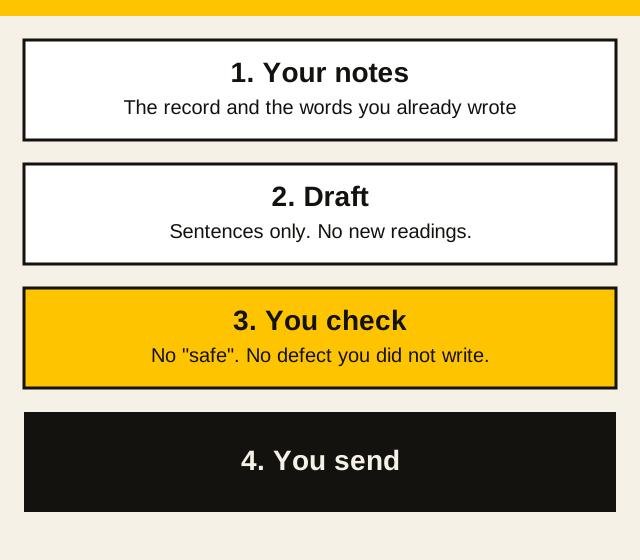
Do this in order. The whole job fits on a phone.
- Open a note. Type the facts you already have: what they asked for, the price you decided, what is not included, and any line you are copying from the record. Leave the house number out when a town will do.
- If the question is whether an appliance is safe, close the app. That decision is yours, on the job, as the registered engineer. The back of your Gas Safe ID card is the note of the work you are qualified to do. The chat has not seen it.
- Paste the prompt for this job. Fill the brackets with your own words. If you do not know yet, leave
[still to confirm]. - Read the draft against your notes, out loud if you are in the van. Delete any date, price, reading, defect, or compliance word you did not type.
- Send it yourself, from your own phone or email. Put the address back in the message you send. The chat does not send the record, and it does not sign it.
A boiler or install quote
Walk the job first. Talk the note in short lines: what they asked for, the appliance you actually saw if you are quoting to change it, who buys it, how you want the work described, and what is not included. Voice typing on the phone is enough. Fix any word it got wrong before you paste. Decide the price. The tool does not know what you need to earn, and it has not tested anything.
You are helping a UK gas engineer write a quote for a boiler install or a gas appliance install. UK English. Use pounds.

Do not invent dates, prices, readings, or compliance claims. Do not say the appliance, the flue, the gas supply, the ventilation, or the installation is safe, fine, passed, satisfactory, or compliant. Do not add models, flue types, measurements, or scope that are not in the notes. If something important is missing, write [still to confirm] and leave it blank.

Notes from the visit:
[paste your notes, after you have corrected them]

Price I have already decided: £[amount]
Who supplies the appliance: [me / the customer / named supplier]
VAT: [not registered / included at 20% / added at 20%]
Included: [paste]
Not included: [paste]

Write a short quote the customer can read on a phone. Put the price near the top. List what is included and what is not included. End by asking them to reply yes if they want the job booked.
List the exclusions for this gas install quote as short lines a customer can read on a phone. Use only the exclusions I give you. Do not soften them, and do not add new ones. Do not invent dates, prices, readings, or compliance claims. UK English.

Exclusions: [paste]
Read every number against your notes before you send it. Extra work after they have said yes is a variation note, with a new figure you have decided, not a new price from the chat. The longer quoting pages are AI for quoting jobs and the quote template.
A site risk assessment or method statement is a different sheet from the gas record. The RAMS guide is the draft you still check on the actual site. It does not decide whether an appliance is safe. The Monday briefing next to boilers and hot work is the toolbox talks for plumbers and heating engineers. Those talks are not a gas safety check.
A cover note with the gas safety record
This is the job I would not hand to a chat tool on its own. You have already done the check. You have already written the record, including any safety defect and any remedial action, in your own words. You have signed it, or you are about to, as the registered engineer. The cover note is a short message to the landlord or the tenant that sits with that record. It repeats only those recorded facts. It does not fill a blank on the form, and it does not soften a defect into a different sentence.
Turn these notes into a short cover note to send with a landlord gas safety record. UK English. The reader is a landlord or a tenant.

Repeat only the facts I paste. These are the words I have already recorded. Do not rewrite a defect into different words. Do not invent dates, prices, readings, addresses, registration numbers, or compliance claims. Do not say an appliance, a flue, or the installation is safe, fine, passed, satisfactory, or compliant. Do not add a defect, a model, or a reading that is not in the notes. If something is missing, write [still to confirm].

What the record already says, in my words: [paste only the lines you are willing to repeat]
Defects I have already written on the record: [paste, or "none written on the record"]
Remedial action I have already written on the record: [paste, or "none written on the record"]

The record itself is signed by me, the Gas Safe registered engineer. Do not sign this draft. Do not add my registration number unless I have typed it here.
Read the cover note against the record, line by line. If a defect has been reworded, put your words back. If the draft says the check has been passed, and the record does not say that, take the sentence out. Then you send your own copy of the record, in the way you already do. The chat does not issue it.
A customer update or appointment reminder
Most updates are one line: you are on the way, you need them to be in, the visit has moved to a day you have already agreed. Write those yourself when they are that short. Use the tool when the note is messy and you want it in an order they can follow. Do not invent a new date. Do not tell them an appliance is fine.
Rewrite this as a short customer update or appointment reminder for a UK gas job. Polite, plain, no jargon.

Do not invent dates, prices, readings, or compliance claims. If I have not typed the appointment date, write [date still to confirm]. Do not say an appliance, a flue, or the installation is safe, fine, passed, satisfactory, or compliant. Do not add a discount, a site visit, or an apology I did not write.

What I want them to know: [paste]
Appointment, if I have already agreed one: [paste, or "none typed"]
What I need from them: [paste, or "nothing"]
How they can reach me: [phone or email]
If the visit changes the price or the work, that is the variation note, not a softer sentence in this text.
Chasing an invoice
A chaser is the invoice number, the amount, and the date you sent it. Do not ask the tool to invent a late fee, or to threaten court, unless you have already decided to say that. Do not let it describe the gas work as passed.
The invoice and late-payment guide is the longer version, including the difference between a business customer and a householder. Use that page for the legal lines. The prompt below is the short chaser.
Write a short polite chaser for an unpaid UK gas-work invoice. UK English.

Do not invent dates, prices, readings, or compliance claims. Do not add interest, a late fee, or a threat of court unless those words are already in my notes. Do not change the amount or the dates. Do not say the work, the appliance, or the installation was safe, fine, passed, satisfactory, or compliant.

Invoice number: [number]
Amount: £[amount]
Date I sent it: [date]
What the work was, in my words: [one line]
How I want paying: [bank transfer to the details already on the invoice]
Put the bank details on the invoice you send. Do not paste them into the chat.
Which tool for which job
These are tools already used in the guides on this site. I am not copying a price or a message cap. Those change. The company's own page is the place to read them on the day you pay.
| Job | A tool that suits it | What it is for |
|---|---|---|
| The wording: a quote, a cover note, a customer update, or an invoice chase | ChatGPT (opens in a new tab), Gemini (opens in a new tab) or Copilot (opens in a new tab) | Sentences. The free tools guide is the wider list, Claude included. |
| The enquiry, the diary, the quote and the invoice in one place | Tradify (opens in a new tab) or ServiceM8 (opens in a new tab) | Job management. What their own sites say is on the tradesmen guide and the quoting apps guide. |
| The books | FreeAgent (opens in a new tab) | Accounting software. The tradesmen guide links FreeAgent's own page. |
What not to paste in
Leave these out, even when they are already on the phone:
- the customer's full address, and a photo of the appliance or the record if the house number is in the shot
- a photo of your Gas Safe ID card
- card numbers, one-time codes from texts, and bank details
- your UTR
- readings from a different job that is still in the same chat
The reasons, and the training switches in ChatGPT, Gemini and Claude, are in what not to put into ChatGPT. A town and the work is enough for the draft. Start a fresh chat when the job changes.
What this will not do
It will not look at a boiler and tell you it is safe. It will not classify a defect. It will not make a person Gas Safe registered, and it will not read the back of the ID card. It will not sign the record. It will not remember that the landlord wants the copy before a new tenancy starts. It will not get you paid.
The weekly email is the newsletter. News from UK sites, which is a different job from this how-to, is on AI on site.
Use one job this week. A quote you were going to write anyway, or a cover note that repeats a record you have already signed, is the right size. The prompts above are the start. The guides linked from each section are the detail.
Common questions
Can ChatGPT decide if a gas appliance is safe?
No. That decision stays with the Gas Safe registered engineer who looked at the appliance. HSE says every landlord gas safety check must be done by a Gas Safe registered engineer, and that in domestic properties work on gas fittings must be carried out by a Gas Safe registered engineer who is qualified to do the work. Regulation 3 of the Gas Safety (Installation and Use) Regulations 1998 says no person shall carry out work on a gas fitting or gas storage vessel unless they are competent to do so. A chat tool must not say an appliance is safe, fine, passed, or compliant.
Can it write or rewrite a landlord gas safety record?
No. HSE says the engineer should only issue the record once the required checks are done, and the record has to include that engineer's name, registration number and signature. A chat tool can draft a cover note that repeats words you have already written on the record. It must not change a defect line, invent a reading, or sign.
Can it price a boiler or gas appliance install?
No. You type the price you have already decided, and the scope and exclusions from the visit. The draft must not invent a date, a price, a reading, or a compliance claim.
What should a gas engineer not paste in?
The customer's full address, a photo of the gas safety record or your Gas Safe ID card, card numbers, one-time codes, bank details, and your UTR. The guide on what never to paste into ChatGPT is the longer list.
Get it free every week
Free when you sign up: the UK Trades AI Prompt Pack, with prompts for quotes, chasing payment, tax admin, and customers.